
“One of the main topics in Frankfurt will be asset structuring using funds at family offices and asset managers.”
Family offices, family funds, Liechtenstein as a fund domicile, and an exchange of ideas at the Frankfurt am Main financial center. Markus Hill spoke to David Gamper, Managing Director of the LAFV Liechtenstein Investment Fund Association, about the association’s current activities and topics. Other topics of discussion included the increasing international attractiveness of the location against the backdrop of the discussion at this year’s event in London, growth, regulation (UCITS, AIFM), and the Omnibus Simplification Package. The topics of “digital assets, blockchain, and tokenization” were also addressed. This year, the association will continue its intensive dialogue with potential fund initiators at the FONDS professionell KONGRESS in Mannheim, Munich, and Hamburg, together with Liechtenstein Finance.
Hill: How do you currently assess the development of Liechtenstein as a fund location in an international comparison?
Gamper: Liechtenstein has developed extremely positively in recent years. Growth in assets under management was well above the European average. We may be a small location, but we are highly specialized and extremely flexible. The combination of EEA membership, a focus on white/private label funds, modern regulation, and short decision-making paths between market participants and authorities makes Liechtenstein particularly attractive for many fund initiators – especially when it comes to cross-border solutions. Of course, we are also feeling the effects of the current geopolitical situation, in particular the US government’s customs policy, which has led to a slight decline in assets under management this year. In the first half of the year, the number of fund launches also declined slightly – but this trend has reversed since the middle of the year. In the third quarter, we were already able to more than compensate for the decline, and the industry is looking to the future with great optimism.
Hill: How do you assess the regulatory framework for fund companies and fund initiators in Liechtenstein? Are there any planned changes that are particularly relevant?
Gamper: At the EU level, both the AIFM and UCITS directives have been revised. As part of this European revision, adjustments are being made in the areas of delegation and reporting, in particular, and new regulations on liquidity management and lending by AIFs are also being introduced. In Liechtenstein, we are currently in the process of adapting national fund laws to implement these directive changes. There is a broad consensus that the options and leeway provided by the European Commission should be used in such a way that no stricter regulations are created that go beyond the EU requirements. The aim is rather to increase flexibility for market participants. Against this background, I consider the regulatory framework for fund companies and fund initiators in Liechtenstein to be extremely advantageous.
Hill: Everyone is talking about the Omnibus Simplification Package at the moment. Does this also have an impact on the fund industry? Are you already noticing any relief?
Gamper: So far, we have hardly noticed any direct relief. The sub-packages published to date are primarily aimed at the real economy. We are following further developments with great interest, as in some areas it could become even more challenging for the financial sector – hopefully only temporarily. As things stand at present, financial institutions are required to produce sustainability reports, while at the same time, the Omnibus Simplification Package has significantly reduced the amount of data that companies are required to provide. This is likely to mean additional work and higher costs for the fund industry in the short term, as data gaps will have to be filled, for example, through the use of ratings. We are therefore eagerly awaiting seeing how the implementation develops in practice.
Hill: To what extent do digital assets, blockchain, and tokenization play a role in the Liechtenstein fund industry? Are there any concrete examples yet?
Gamper: Digital assets have almost become a tradition in Liechtenstein – the first crypto asset fund under European regulation was launched here in 2018. There are now several funds in this area, but the volume remains manageable. The tokenization of funds is particularly exciting at the moment: fund shares are mapped entirely on the blockchain, where they can be traded cost-effectively and transparently. The first pilot projects have already been successfully implemented. The market is still in its infancy, but the potential is enormous.
Hill: I recently saw several videos with you on the Liechtenstein Finance website. Is there a cooperation with the Liechtenstein Investment Fund Association?
Gamper: Yes, in a way. We, as the Liechtenstein Investment Fund Association (LAFV), are – like the other financial center associations and the government of the Principality – members of Liechtenstein Finance, an association organized under private law. The association aims to raise the profile of Liechtenstein as a financial center both at home and abroad by communicating the strengths and special features of the location in a targeted manner. Liechtenstein offers excellent conditions—not only for the fund industry, which is still too little known in Europe. We want to change that together.
Hill: I recently saw several videos with you on the Liechtenstein Finance website. Is there a cooperation with the Liechtenstein Investment Fund Association?
Gamper: Yes, in a way. We, as the Liechtenstein Investment Fund Association (LAFV), are – like the other financial center associations and the government of the Principality – members of Liechtenstein Finance, an association organized under private law. The association aims to raise the profile of Liechtenstein as a financial center both at home and abroad by communicating the strengths and special features of the location in a targeted manner. Liechtenstein offers excellent conditions—not only for the fund industry, which is still too little known in Europe. We want to change that together.

Hill: And what are these conditions?
Gamper: A complete list would go beyond the scope of this interview. Nevertheless, I would like to highlight a few key location advantages. There is EEA membership with corresponding access to the EU single market and regulatory flexibility thanks to the leeway granted by the EU Commission. Liechtenstein is considered a haven for assets, has a stable political and economic order, no national debt, and an AAA rating from S&P Global Ratings. We have efficient authorities and short decision-making processes, which enable a rapid time-to-market for new products. We also have an attractive tax system with low rates; at the fund level, taxation is eliminated, thus avoiding double taxation.
Hill: You held an event with a panel discussion in London in October. What points were discussed in particular?
Gamper: The main interest in London was in asset structuring using funds. This topic resonated strongly with the audience, as fund structures offer considerable advantages. The aforementioned strengths of Liechtenstein as a location were expressly confirmed by the fund initiators present and found to be convincing. Offshore solutions remain popular, particularly in the United Kingdom, as they are generally cheaper than fund structures within the EU. However, they offer significantly less legal certainty—an aspect that many participants were unaware of.
Hill: What events are still to come?
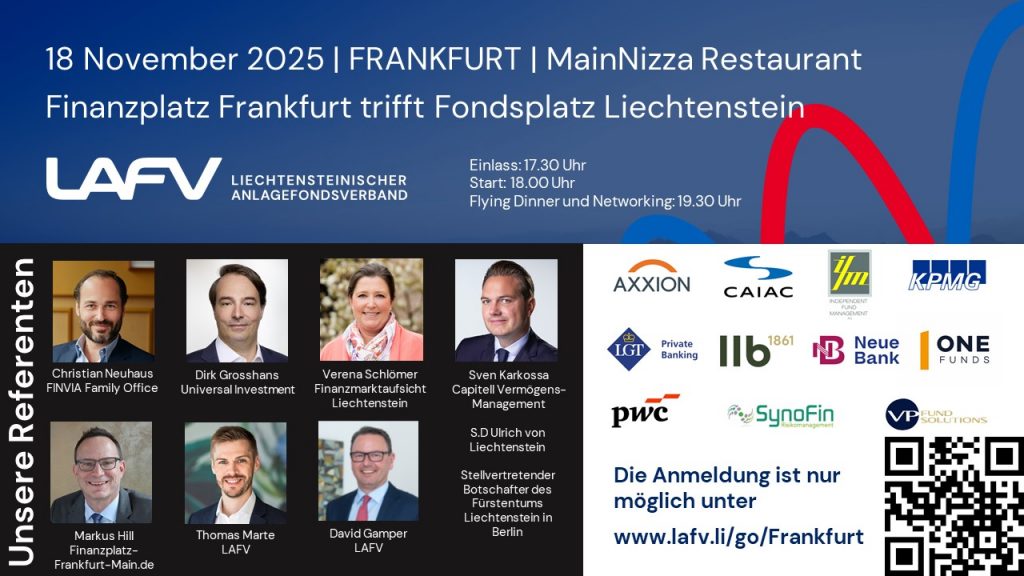
Gamper: On November 18, 2025, “Finanzplatz Frankfurt meets Finanzplatz Liechtenstein” will take place again. One of the focal points in Frankfurt will be the topic of asset structuring using funds at family offices and asset managers. However, we will also highlight cases in which it is particularly interesting to choose Liechtenstein as the fund domicile for white label funds. The FONDS professionell KONGRESS in Mannheim on January 28/29, 2026, will once again take place with the support of Liechtenstein Finance (booth). Visitors will have the opportunity to find out more about the fund center at the booth and talk to structuring experts about specific fund projects. In the presentation, a fund founder will report on his successful fund project and his positive experiences in Liechtenstein. In spring, the LAFV events will take place in Munich and Hamburg on April 21 and 28, 2026. Fund founders will report on Liechtenstein’s unique location advantages, and the tax aspects of funds will be highlighted. We are also in contact with the Liechtenstein Financial Market Authority (FMA) and hope to welcome a representative who will provide insights into the approval process and supervisory practices for funds.
Hill: Thank you very much for the interview.
INFORMATION / REGISTRATION: “FRANKFURT FINANCIAL CENTER meets LIECHTENSTEIN FINANCIAL CENTER”
Quelle: Institutional-Investment
Dialog & Information:
FINANZPLATZ FRANKFURT AM MAIN auf LINKEDIN – KANAL
FINANZPLATZ FRANKFURT AM MAIN auf LINKEDIN – GRUPPE
FONDSBOUTIQUEN auf LINKEDIN – KANAL
Foto: UNSPLASH