
What factors convince a family office when selecting asset managers—and what role do independent fund boutiques play in this process? It is not the size of a provider that is decisive, but rather the quality of its strategy and the demonstrable added value for the client. In a conversation with Markus Hill, Klaus Deng of BREHMER & CIE explains to FINANZPLATZ FRANKFURT AM MAIN what matters most when selecting external managers, why wealth preservation is more than just a matter of inflation, and when customized fund structures can be beneficial. Following his keynote presentation on these topics on November 10 in Frankfurt, the discussion also turns to Liechtenstein as a fund hub: What arguments actually matter from the perspective of a German family office? A conversation about entrepreneurial thinking, conflicts of interest, and the art of not unnecessarily complicating complex wealth structures.
Hill: Mr. Deng, family offices are tasked with preserving and growing family wealth across generations. In your view, what distinguishes a family office’s investment philosophy from traditional wealth management? What role do wealth preservation, returns, liquidity, and entrepreneurial thinking play in this context?
Deng: The key difference between asset management and a family office lies less in the size of the assets than in the complexity of the structures and the number of decision-makers. This is particularly true when a client holds equity stakes in operating companies for which he bears responsibility. In the next generation, the owners of such companies are not automatically entrepreneurs. Here, it is important to support a structure that keeps both the family interests of the owners and the necessary corporate development in mind. In such constellations, the family office acts as a facilitator in the “magic triangle” between the shareholders’ meeting, management, and corporate bodies, such as the supervisory board or family foundation.
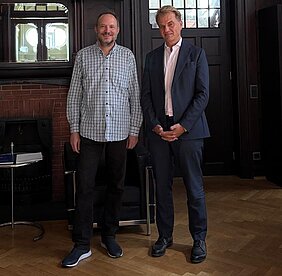
Hill: BREHMER & CIE. follows a multi-manager approach. What criteria do you use to select external fund managers and asset managers? How important are performance, risk management, personal integrity, and the stability of the investment team?
Deng: When developing an investment strategy for clients, it is essential to balance market returns with excess returns. The key factor is whether a manager can consistently generate alpha with their strategy—that is, earn more during favorable market conditions and lose less during unfavorable ones—or whether they merely track the market return (beta). Performance and costs must also be measured against this standard. Only an independent family office without its own asset management division can act here as an intermediary between the market and investor sentiment, free from conflicts of interest. Incidentally, the greatest risk for wealth holders lies in creeping expropriation due to persistently low net returns that fall below the rate of money supply growth.
Hill: Large international asset managers have considerable resources and established distribution structures. In contrast, what opportunities do independent fund boutiques have? What must a small, specialized manager offer to even make it onto the agenda of a professional family office?
Deng: Size or reach are not decisive factors for us as a family office. In our experience, both large asset managers and smaller fund boutiques have their place. A prerequisite for a potential mandate is a clear strategy that provides added value for the client and has a proven track record in practice.
Hill: Entrepreneurial families often invest not only in traditional stocks and bonds but also in real estate, corporate equity investments, and private markets. What specific requirements does this entail for asset structuring? When might a proprietary fund or a private-label fund structure make sense—and when might it not?
Deng: We agree with Albert Einstein: “One must make things as simple as possible, but not simpler.” Whether an additional structure such as a private-label fund offers added value depends on the client. Advantages in terms of costs, taxes, and asset pooling can be calculated precisely. At the same time, this creates another structure with its own organizational requirements. Whether this is structured as a co-ownership association dependent on service providers or as a corporation with its own legal personality and corresponding shareholder rights must be carefully weighed. Our task is to disclose all advantages and disadvantages and evaluate them together with the client.
Hill: When establishing individual fund structures, various European fund jurisdictions come into consideration. From a family office’s perspective, which criteria are decisive: legal certainty, costs, flexibility, service quality, tax considerations, or cooperation with the relevant institutions?
Deng: In recent years, we have observed a convergence of criteria among potential European custodian jurisdictions, particularly with regard to service and flexibility. A clear competitive advantage exists in jurisdictions where statutory value-added tax does not apply to financial services such as custody and management.
Hill: On November 10, you will give a presentation at “Frankfurt Financial Center Meets Liechtenstein Fund Center” on the topics of family offices, wealth structuring, and product selection. Following your presentation, I, Markus Hil, will moderate a panel discussion on “Family Offices & Fund Domiciles,” and you’ll be providing some initial food for thought to kick off the discussion. Liechtenstein is increasingly positioning itself as a hub for private and white-label funds. From the perspective of a German family office, where do you see interesting use cases? What questions would Liechtenstein need to answer convincingly when compared to established locations like Luxembourg?
Deng: Liechtenstein is among the fund jurisdictions that are sending a clear signal to the market by eliminating the statutory value-added tax on financial services. We also see the political will to promote the establishment and management of investment funds in Liechtenstein in our collaboration with Liechtenstein-based asset management companies, as well as in the responsiveness of the Liechtenstein Financial Market Authority.
Hill: Finally, let’s look ahead: What developments will particularly shape the work of family offices in the coming years? Consider, for example, generational transition, private markets, digitalization, artificial intelligence, or new forms of wealth structuring. And where do you see potential for professional exchange between Frankfurt and Liechtenstein?
Deng: Preserving real wealth is becoming an increasing challenge in Germany. While inflation is a critical factor for people without significant wealth, this metric falls short for wealth holders. Long-term money supply growth in the eurozone exceeds 5.0% annually. Taking income taxes and management fees into account, an annual return of over 7.0% is therefore required. It is the asset manager’s responsibility to counteract this creeping erosion of wealth. In the political arena, we are seeing efforts across Europe to impose higher taxes on investment income and wealth. Conclusion: Better to be an owner than a creditor!
Hill: Thank you very much for the interview.
Event Announcement: “Frankfurt Financial Center Meets Liechtenstein Fund Center”
Dialogue & Information:
FINANCIAL CENTER FRANKFURT AM MAIN on LINKEDIN – CHANNEL
FRANKFURT AM MAIN FINANCIAL CENTER on LINKEDIN – GROUP
FUND BOUTIQUES on LINKEDIN – CHANNEL
FINANZPLATZ-FRANKFURT-MAIN.DE, DACHLI Region & FONDSBOUTIQUEN.DE (2026) – Topics, Interests, Dialogue (Selection & “Snapshots”)
February 25, 2026, Frankfurt – “Frankfurt am Main Financial Center Meets Wealth Management”
(Markus Hill – Moderators: Christian Neuhaus – FINVIA, Sven Karkossa – Capitell Vermögens-Management AG, Noel Zeh – Wunderland Capital)
February 26, 2026, Frankfurt – “Forum for Digital Assets (FDV)”
Editorial Team – Special Feature: “Frankfurt am Main as a Financial Center Meets Wealth Management & Digital Assets”
(Interviews / Guest Contributions, “Support” & MORE: info: markus-hill.com)
March 17, 2026, Frankfurt – Private Markets Excellence Forum – “Private Markets, Family Offices & Foundations – Due Diligence & Outlook 2026”
(Markus Hill – Fireside Chat: J. Paulo Dos Santos – Managing Director, VIRATIO GmbH)
Interview with Christian Hommens – SMART IMPACT INVESTING & PRIVATE MARKETS
Spring 2026: Investor Study “Preferences of Institutional Investors in Real Estate & Alternative Investments”
(Markus Hill – Moderator, Podcast: Sebastian Thürmer, “artis & x” – Example 2025)
April 16, 2026 – “köln let’s talk” – Bettina Timmler – Real Estate & Dialogue
(Media Partnership)
May 12, 2026, Frankfurt: “Value Investing & Commodities & MORE”
(Markus Hill – Moderator & brief introduction “Fund Boutiques & the U.S. Formula” – Alex J. Rauschenstein & Urs Marti, SIA FUNDS AG – FINANCIAL CENTER SWITZERLAND)
June 17, 2026, Zurich: Insights – “Family Offices & Fund Boutiques” – The Mountain Talks Summit – FUNDPLAT
(Presentation – Markus Hill)
September 24, 2026, Lucerne: “Swiss Digital Finance Conference 2026” – Markus Hill (PARTNER) speaks with Jan Carlos Janke, lecturer in Digital Business & Innovation at Lucerne University of Applied Sciences and Arts – Computer Science
November 10, 2026, Frankfurt: “Frankfurt am Main Financial Center Meets Liechtenstein Financial Center”
(Markus Hill – Moderator – LAFV Liechtenstein Investment Fund Association: Panel & Presentations)
Input, ideas, and suggestions on the topics mentioned above are welcome:
info@markus-hill.com / +49 (0) 163 4616 179
Photo: Frankfurt Financial Center
Source: IPE. DA.CH